Landmark Judgment: Sanjabij Tari v. Kishore S. Borcar—Supreme Court’s Roadmap to Reduce Cheque-Bounce Backlogs

Faster summons, court-managed digital payments, structured complaints and revised compounding costs form the Court’s response to delays in cheque-dishonour litigation.
Navyug News | Judgment summary and analysis

Case detail | Information |
Court | Supreme Court of India |
Case | Sanjabij Tari v. Kishore S. Borcar & Another |
Appeal | Criminal Appeal No. 1755 of 2010 |
Neutral citation | 2025 INSC 1158 |
Decision | 25 September 2025 |
Bench | Justices Manmohan and N.V. Anjaria |
Judgment authored by | Justice Manmohan |
Principal legislation | Negotiable Instruments Act, 1881 |
Implementation deadline directed | Not later than 1 November 2025 |
A payment dispute that became a reform judgment
A dishonoured cheque can disrupt a household or a small business. When litigation lasts years, the promise of a reliable payment instrument weakens.
In Sanjabij Tari v. Kishore S. Borcar, the Supreme Court addressed both an individual conviction and the systemic delays affecting cases under Section 138 of the Negotiable Instruments Act, 1881.
Its response combines legal clarification with practical administration: improve service, identify the real defence early, make payment easier and reward timely settlement. Speed, however, must operate alongside fair procedure and the accused’s opportunity to contest liability.
The dispute and the outcome
The litigation concerned a friendly loan of ₹6 lakh and a dishonoured cheque. The Trial Court convicted the accused, and the Sessions Court upheld the decision. The Bombay High Court at Goa reversed those findings in April 2009.
The accused questioned the complainant’s financial capacity and claimed that a signed blank cheque had been supplied for another purpose. The Supreme Court examined the evidence and statutory presumptions rather than treating those assertions as sufficient by themselves.
It restored the Trial Court and Sessions Court judgments and directed payment of ₹7.5 lakh in fifteen monthly instalments of ₹50,000. These were case-specific directions, not a standard repayment schedule for all cheque-bounce cases.
Signed cheques and rebuttable presumptions
The Court reaffirmed the operation of Sections 118 and 139. Once execution is admitted, presumptions concerning consideration and discharge of a legally enforceable debt or liability arise.
They remain rebuttable. The accused can raise a probable defence, including through material supplied by the complainant. But an unsupported assertion does not automatically displace the statutory framework.
The Court also rejected the proposition that a cash transaction breaching Section 269SS of the Income Tax Act, 1961, automatically becomes unenforceable under Section 138. It distinguished tax consequences under Section 271D from invalidating the debt.
This does not legitimise tax violations. It separates the legal consequences of non-compliance from the enforceability question in cheque-dishonour proceedings.
Why the backlog demanded intervention
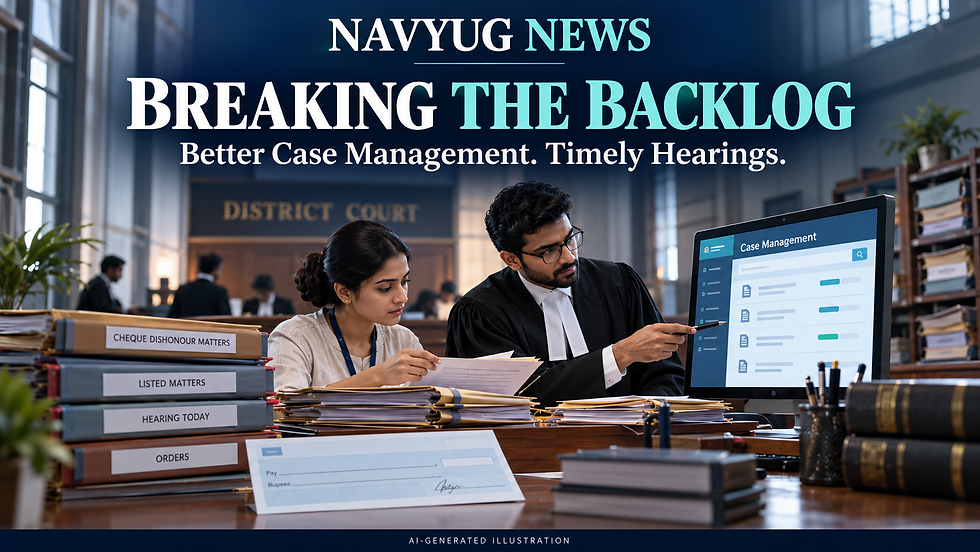
Citing National Judicial Data Grid figures as of 1 September 2025, the judgment recorded 6,50,283 pending Section 138 cases in Delhi district courts, 1,17,190 in Mumbai and 2,65,985 in Calcutta. It stated that these cases represented 49.45% of Delhi’s total trial-court pendency.
These are historical figures cited in the judgment, not today’s live backlog.
The Court identified service of summons as a major source of delay. It also stressed that the law seeks payment and confidence in cheques, rather than punishment primarily for retribution. That rationale explains its emphasis on earlier resolution.
Faster service—with safeguards
For Section 138 complaints, summons must additionally be issued dasti, enabling service through the complainant rather than relying exclusively on usual modes.
Courts must also use electronic service under applicable notifications and rules. Complainants should provide relevant email, mobile or messaging details, supported by an affidavit verifying that they belong to the accused.
An affidavit of service is required. False affidavits can attract action according to law.
The safeguard matters: faster communication cannot justify sending notice to an unverified contact or falsely claiming delivery. Electronic service remains tied to the applicable legal framework.
Court-managed digital payments
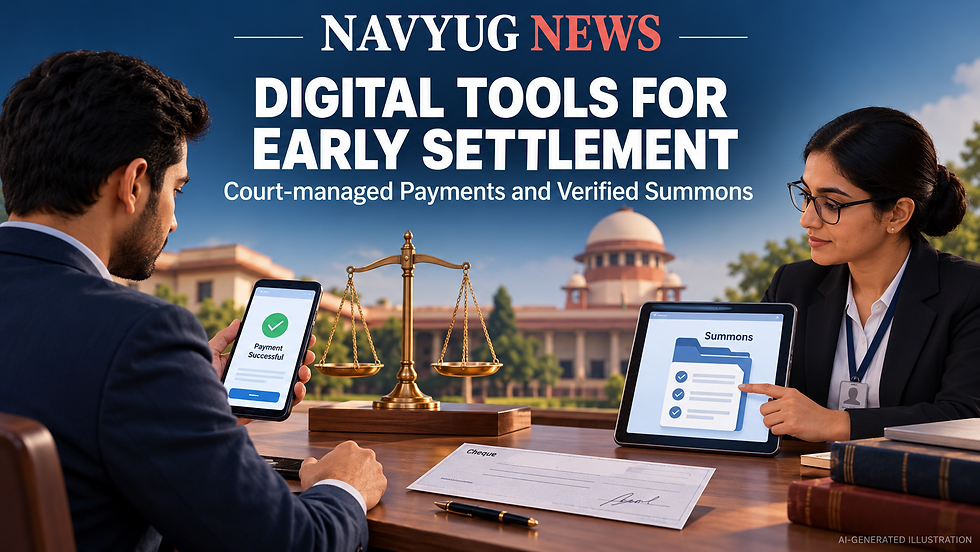
Principal District and Sessions Judges were directed to establish secure online payment facilities through QR codes or UPI links.
Summons should explain the option to pay the cheque amount at the initial stage. The complainant must be informed, receipt confirmed and appropriate judicial orders passed for release of money and compounding or closure according to law.
Payment does not automatically erase proceedings. The judicial step remains essential. Litigants should verify any purported court payment facility through official channels before transferring money.
A structured complaint and a clearer defence
Every complaint must contain a prescribed synopsis immediately after the index. It includes party details, cheque particulars, dishonour information, statutory notice, cause of action, jurisdiction and relief sought.
The Court also held that a separate summons to hear the accused before cognizance, under Section 223 BNSS, is not required for Section 138 complaints. This does not dispense with subsequent summons or trial safeguards.
At the initial post-cognizance stage, Magistrates may ask focused questions about the account, signature, delivery, liability, defence and willingness to compound. Responses must be recorded in the presence of the accused and counsel.
The purpose is to identify genuine disputes early, not secure automatic admissions.
Summary trials, interim compensation and appearances
The Court reiterated that conversion from a summary trial to a summons trial requires cogent and sufficient reasons.
It called for early exercise of Section 143A powers where appropriate. Interim compensation is therefore not automatic merely because a complaint exists.
The directions also favour physical-court listing after service, with personal-appearance exemptions when warranted by the facts. Digital listing may be used before service.
Where evening courts hear cheque cases, High Courts should set realistic financial limits. The judgment considered Delhi’s then ₹25,000 threshold too low.
Revised costs encourage earlier compounding
The Court modified the graded framework associated with Damodar S. Prabhu, extending the incentive to settle before defence evidence.
Stage of payment | Revised additional compounding cost |
Before recording defence evidence | No cost or penalty under the guideline |
After defence evidence, before trial judgment | 5% of cheque amount |
Sessions Court or High Court in revision or appeal | 7.5% |
Supreme Court | 10% |
These amounts are additional to payment of the cheque amount. The judgment says courts may allow compounding; it should not be described as compulsory settlement or automatic dismissal.
The Court also recognised the availability of the Probation of Offenders Act, 1958. Where additional settlement demands obstruct resolution, it identified possible judicial approaches involving a guilty plea and sentencing or probation powers. These require case-specific legal consideration, not a mechanical outcome.
Monitoring the courts with the heaviest identified burdens
District and Sessions Judges in Delhi, Mumbai and Calcutta must maintain dashboards covering pendency, disposals, settlements, adjournments and procedural stages.
Monthly reviews and quarterly reports to High Courts were directed. The Chief Justices of Delhi, Bombay and Calcutta were requested to establish administrative committees meeting at least monthly, exploring experienced Magistrates, mediation, Lok Adalats and other dispute-resolution mechanisms.
These geographically specific monitoring directions should not be presented as identical dashboard obligations imposed on every district nationwide. The judgment required implementation of its guidelines by 1 November 2025; that deadline does not itself prove uniform compliance.
What makes the decision significant
The ruling treats delay as a practical problem requiring practical solutions. Better information, verified service and accessible payment can reduce avoidable hearings.
For complainants, the aim is earlier recovery. For accused persons, genuine defences remain available while delayed settlement carries greater costs.
Success will depend on secure systems, reliable records and consistent court administration. The judgment offers a roadmap—not a claim that the backlog has already disappeared.


Comments