Is RBI Becoming a Political Tool? What Bank Complaints, Mis-selling and Charges Really Reveal

Rising grievances demand tougher scrutiny of India’s banking regulator. But proving political bias requires more than counting complaints.
Navyug News | Analysis | Updated 3 October 2026
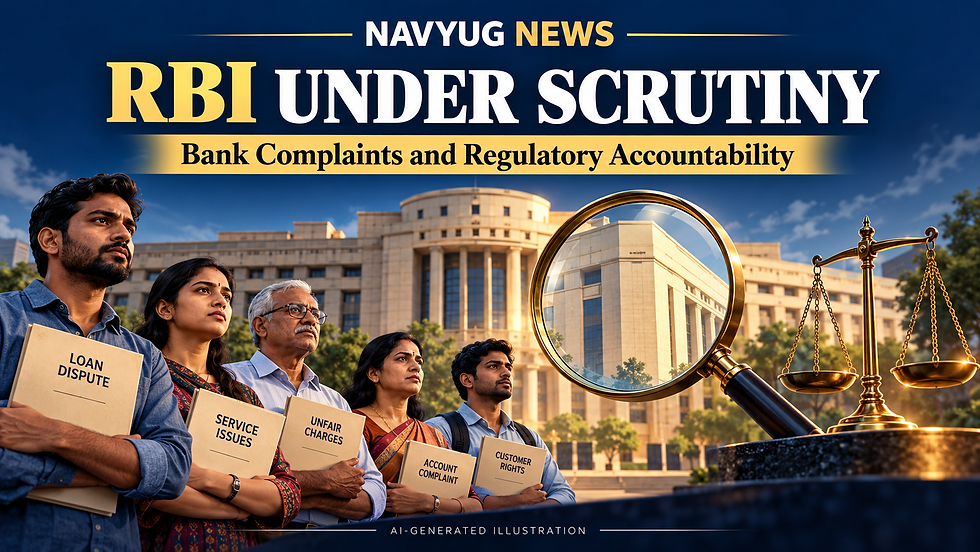
The customer’s question: who protects me?
Imagine a pensioner visiting a bank for a safe deposit and leaving with an investment-linked insurance policy they barely understand. Elsewhere, a worker discovers repeated balance-related deductions. Both complain; both receive replies quoting terms and conditions.
These illustrative situations capture a fundamental concern: when customers challenge powerful financial institutions, is the Reserve Bank of India an effective protector?
That question deserves investigation. So does the sharper allegation that RBI is becoming a political tool. However, frustration with banks, shortcomings in supervision and political interference are distinct propositions. Treating them as interchangeable would weaken a serious case for accountability.
The available evidence supports scrutiny of customer protection. It does not, by itself, establish partisan control of RBI’s regulatory decisions.
Complaints are rising—but read the figures correctly
Reporting on RBI’s Ombudsman annual report records 13,34,244 complaints in FY2024–25, up 13.55% from 11,75,075 a year earlier. This is the wider complaint framework, not a count of complaints individually adjudicated by Ombudsman offices.
RBI’s own annual report separately records approximately 2.96 lakh complaints received at Ombudsman offices, compared with 2.93 lakh the previous year. Most concerned banks, and major areas included lending and digital banking.
The distinction prevents exaggeration. The broader system receives communications that may require screening, referral or other handling.
Rising complaints can indicate worsening service, greater awareness, easier reporting or growth in banking activity. These explanations can operate together. A meaningful assessment therefore needs complaint rates relative to customers or transactions, the nature of grievances and their outcomes.
Nevertheless, escalating dissatisfaction is a warning. A regulator should investigate recurring patterns before they become routine customer experiences.
Closing a complaint is not always resolving it
The reported Ombudsman-office disposal rate fell from 95.10% to 93.07% in FY2024–25. That warrants attention, but “disposed of” does not mean every complainant received compensation or a favourable finding.
A complaint may close through settlement, rejection or a procedural decision. Customers need to understand the reason.
The stronger public-interest questions are: how many customers obtained relief? How long did it take? Which banks repeatedly generated similar grievances? Did complaints lead to corrective changes?
For a person disputing a deduction, a closure message without a clear explanation can feel like institutional indifference. Regulators should measure both administrative throughput and the quality of redress.

Are bank charges at historic highs?
Recent reporting of a parliamentary reply puts minimum-balance charges collected by public and private banks at approximately ₹7,086 crore in FY2025–26. Private banks accounted for ₹4,948.71 crore and public-sector banks ₹2,137.92 crore. The private-bank FY2025–26 figures were described as provisional.
These are substantial sums. However, a claim that all banking penalty charges are at an all-time high requires a consistent historical series covering comparable institutions and charge categories. The evidence cited here does not establish that broader claim.
Minimum-balance charges, loan-default penalties, card charges and RBI regulatory fines are different measures. Combining them produces a misleading headline.
There is also counterevidence to a blanket accusation: the government’s March 2026 parliamentary answer states that ten public-sector banks had waived minimum-balance penalties on savings accounts, while the remaining two rationalised them. SBI’s waiver dates to March 2020. Current-account collections must therefore not be presented as savings-account penalties.
Small deductions can create large hardship
The same parliamentary answer records ₹8,092.83 crore collected by public-sector banks for minimum-balance shortfalls across FY2022–23 to FY2024–25, covering savings and current accounts.
The government argued that this represented approximately 0.23% of their total income. It also noted that Basic Savings Bank Deposit Accounts, including Jan Dhan accounts, do not require a minimum balance.
A small share of bank income does not establish a small burden on customers. A deduction that appears immaterial in a bank’s accounts may matter greatly to someone facing irregular wages.
The fairness test should examine the customer’s account category, disclosure, notice, charge calculation and available alternatives. It should also ask whether financially vulnerable customers were guided towards suitable basic accounts.
RBI already has rules—implementation is the test
RBI’s minimum-balance framework requires notice of a shortfall and at least one month to restore the balance before relevant savings-account penalties are recovered. Charges must be proportionate and reasonable. The balance must not become negative solely because of these charges.
For covered loans, RBI’s fair-lending rules distinguish penal charges from penal interest. Default-related penalties cannot simply be added to the interest rate, and further interest cannot be calculated on the penal charges themselves. Product-specific exceptions apply.
The existence of safeguards means the investigation should move beyond asking whether rules exist. It should examine compliance.
Were notices delivered? Were deductions calculated correctly? Did banks reverse erroneous charges? Were recurring failures identified through supervision? Publishing another circular cannot substitute for checking what happens in customer accounts.

When banking becomes a sales pitch
Mis-selling concerns arise when a financial product is presented misleadingly, important risks are concealed or the product is inappropriate for the buyer.
A customer may trust the bank’s familiar premises and staff without appreciating that an insurance policy or mutual fund differs fundamentally from a deposit. In the pensioner scenario, the relevant questions include liquidity needs, investment horizon, risk and what was actually explained.
A signed form deserves examination, but a signature alone cannot demonstrate that every representation was accurate. Equally, an investment loss does not automatically prove mis-selling.
The evidence must connect the sales process, disclosure, suitability and consent to the specific complaint. Broad accusations against every bank employee would obscure the institutional incentives that require scrutiny.
A significant reform begins in January 2027
RBI’s 15 June 2026 Responsible Business Conduct amendment directions for commercial banks introduce comprehensive advertising, marketing and sales safeguards, effective 1 January 2027.
They address unsuitable products, misleading or incomplete information, absent explicit consent and compulsory bundling. They require suitability assessments and controls against incentives that encourage mis-selling.
Where mis-selling is established, the directions provide for refund of the amount paid, cancellation where applicable and compensation under the bank’s policy. Related directions cover other institution categories. These are forthcoming protections, not rules already effective on this article’s publication date.
The reform is evidence that RBI recognises conduct risks. Its credibility will depend on implementation: meaningful assessments, accessible evidence and remedies that work beyond the paperwork.
Is supervision fading? The enforcement picture is mixed
RBI’s annual report records 353 penalties totalling ₹54.78 crore in FY2024–25. Subsequent reporting of its FY2025–26 report puts the figures at 241 penalties and ₹26.33 crore.
The decline merits questions, but smaller fines do not automatically prove weaker supervision. Changes in violations, case timing or supervisory interventions can affect annual totals.
Conversely, a high penalty count is not proof that customers are well protected. A regulatory fine does not necessarily compensate the customer who suffered harm.
Assessing effectiveness requires examining repeat violations, corrective-action completion, restrictions where warranted and whether harmful conduct stops. Fine totals are an indicator, not a complete scorecard.
What would establish political bias?
RBI operates within a statutory relationship with government. Section 7 of the Reserve Bank of India Act, 1934, permits government directions after consultation with the Governor where considered necessary in the public interest. That legal structure does not itself prove partisan interference.
A substantiated political-bias finding would need evidence such as selective treatment of comparable violations, documented pressure affecting decisions or departures from established processes benefiting politically connected interests.
None of the complaint or charge totals cited here establishes those facts. Poor customer outcomes can arise from enforcement gaps, capacity constraints or commercial incentives without a political instruction.
Still, RBI should address doubts through clear reasoning and consistent treatment. Institutional independence earns public confidence when its exercise is visible and defensible.
Complaints against banks—and against RBI itself
Under the RBI Integrated Ombudsman Scheme, 2026, effective 1 July 2026, customers must first complain to the covered institution.
An unsatisfactory reply permits escalation; otherwise, the usual waiting period is thirty days or the applicable longer prescribed timeline. Complaints can be filed free at cms.rbi.org.in, generally within ninety days of the applicable timeline expiring or the institution’s last communication, whichever is later.
A grievance about an RBI department is different. RBI’s published complaints page directs such grievances to crpc@rbi.org.in, with the department, facts and supporting documents identified. This administrative route does not make the Ombudsman a forum for reviewing every RBI supervisory decision.
Accountability must reach the customer
RBI should publish clearer institution-level complaint outcomes, distinguish procedural closures from substantive relief and explain how repeated grievances inform supervision.
Banks should reassess sales incentives, simplify disclosures and make disputed deductions easy to challenge. Oversight should test whether remedies actually reach customers.
Calling RBI a political tool remains an allegation requiring evidence. Asking whether it is doing enough to prevent recurring customer harm is already justified.
India needs a regulator whose success is visible in fair treatment, effective correction and public trust—not simply in the number of rules it issues.


Comments