Lok Adalats and Arbitration Tribunals: Can They Handle Civil and Criminal Cases?

Tagline: Faster dispute resolution begins with choosing a forum that has the power to resolve your case.
Navyug News | Legal Explainer | 12 October 2026

A cheque-bounce complaint, an unpaid business invoice and a disputed electricity bill may all involve money. Yet they do not necessarily belong before the same forum. The nature of the legal claim, the parties’ agreement and the governing statute determine where a dispute can go.
India’s Lok Adalats and arbitration tribunals offer alternatives to ordinary litigation, but they perform different functions. A regular Lok Adalat facilitates settlement. An arbitration tribunal can decide an eligible dispute even when the parties disagree about its outcome.
The answer to the central question is qualified: regular Lok Adalats can settle eligible civil disputes and compoundable criminal matters. Arbitration tribunals can adjudicate arbitrable civil or commercial disputes, but cannot conduct criminal trials. Permanent Lok Adalats have a distinct statutory jurisdiction that must be considered separately.
Regular Lok Adalats: settlement is the foundation
Lok Adalats have statutory recognition under the Legal Services Authorities Act, 1987. Sections 19–21 provide the principal framework for their organisation, referral of matters and awards.
They can take up eligible disputes already pending before courts and matters at the pre-litigation stage. Their members assist parties in reaching an amicable resolution rather than impose a decision on contested merits. NALSA emphasises that parties must not be pressured into compromise.
Consider a bank seeking repayment from a borrower. The parties might agree on a revised payment schedule or settlement amount. The Lok Adalat can record that lawful agreement. It cannot compel the bank to waive a debt or force the borrower to accept terms merely because the matter has been listed.
Referral is therefore not the same as settlement. An opportunity to negotiate must preserve a meaningful choice about the outcome.
Which civil matters can be settled?
Suitable matters can include money-recovery disputes, motor-accident compensation claims, property disputes and other civil claims capable of lawful compromise. Eligibility still depends on the relief sought, statutory restrictions and the jurisdiction of the court for which the Lok Adalat is organised.
For example, two neighbours might settle a boundary disagreement after examining their documents. A claimant and insurer might agree on compensation. The practical advantage is an enforceable resolution without continuing a contested hearing.
However, the expression “civil cases” is not unlimited. NALSA’s guidance excludes matters relating to divorce from regular Lok Adalat referral. Parties should not assume that settlement discussions can substitute for a judicial decree dissolving a marriage.
A proposed compromise also cannot authorise conduct prohibited by law or dispose of rights the parties have no power to surrender.
Criminal cases: only where the offence is compoundable
Regular Lok Adalats have no jurisdiction over matters relating to offences that are not compoundable under law.
Compounding is a legally recognised process for settling specified offences through the person authorised by the applicable statute. It is not simply an informal agreement that a complainant will stop pursuing a case.
Section 359 of the Bharatiya Nagarik Suraksha Sanhita, 2023 provides the general compounding framework for specified Bharatiya Nyaya Sanhita offences. Some require the court’s permission. Older proceedings may remain governed by the Criminal Procedure Code’s saved provisions, including Section 320, depending on the transitional position.
The exact charge therefore matters. Calling an offence “minor”, “private” or “a family issue” does not make it compoundable.
A Lok Adalat also does not hold a criminal trial, decide guilt on contested evidence or sentence an accused.
Cheque bouncing illustrates the distinction
Section 138 of the Negotiable Instruments Act creates a criminal offence concerning dishonoured cheques, subject to its statutory requirements. Section 147 makes offences under that Act compoundable. Eligible cheque-bounce complaints can therefore be settled through the Lok Adalat process.
The parties may agree on payment and seek the appropriate recording of settlement and disposal. Clear terms should identify the amount, payment dates and steps necessary to complete the agreed resolution.
By contrast, serious non-compoundable offences cannot be converted into Lok Adalat matters merely because someone offers compensation.
The central distinction is statutory permission to compound—not the amount of money involved.
What if settlement fails?
When a regular Lok Adalat cannot secure a compromise, it cannot resolve the dispute by choosing which party is right. Pending litigation returns to the referring court; an unresolved pre-litigation claimant can pursue an appropriate remedy.
This is the principal difference from adjudication. The forum assists negotiation but does not acquire power to impose a contested outcome because negotiations have taken place.
A successful award is deemed a civil-court decree, is binding and has no ordinary statutory appeal. However, exceptional constitutional review may be available on recognised grounds, such as a challenge to the validity of the settlement process. “No appeal” should not be rewritten as immunity from every legal challenge.
Before signing, parties should understand their obligations and retain the award.
Permanent Lok Adalats operate differently
Permanent Lok Adalats under Chapter VI-A are established for specified public-utility services. Their jurisdiction is pre-litigation and depends on the notified service, area and monetary limits.
Public-utility services include statutory categories such as transport, postal services, electricity, water, sanitation, hospital services and insurance, alongside other notified services. They are not general courts for every civil dispute.
Conciliation comes first. If it fails, Section 22C(8) permits a decision on merits only where the dispute does not relate to any offence. NALSA explains this adjudicatory distinction.
The notified pecuniary ceiling is ₹1 crore, as reflected in current state legal-services guidance; older references to ₹10 lakh can mislead.
A person should check the particular Permanent Lok Adalat’s notified jurisdiction before applying.
Can a Permanent Lok Adalat handle criminal matters?
Two separate restrictions must be read together. Section 22C(1) excludes matters relating to non-compoundable offences. Section 22C(8), however, permits adjudication after failed conciliation only if the dispute does not relate to any offence.
Thus, an eligible matter involving a compoundable offence is not automatically excluded from conciliation. But that does not authorise the Permanent Lok Adalat to determine criminal guilt when settlement fails.
It remains a specialised public-utility forum. A monetary claim cannot be relabelled as a service dispute simply to bypass criminal jurisdiction.
This distinction prevents a common mistake: assuming that the word “Permanent” means broader power over every kind of case.
Arbitration tribunals: adjudication based on legal authority
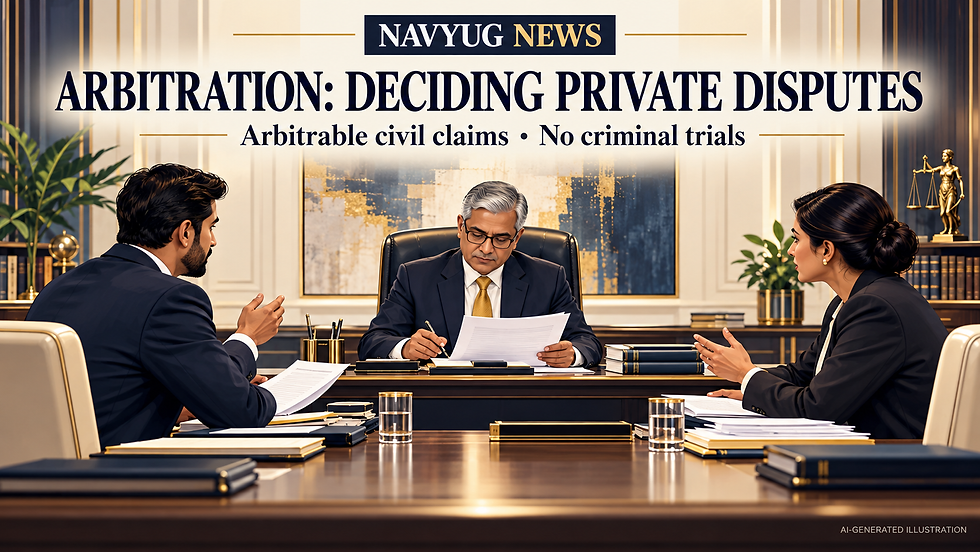
Arbitration is principally governed by the Arbitration and Conciliation Act, 1996. An arbitral tribunal consists of a sole arbitrator or a panel appointed to determine disputes within its jurisdiction.
Ordinarily, arbitration requires a valid written arbitration agreement under Section 7, together with a subject matter capable of arbitration. Statutory arbitration can arise through legislation.
Unlike a regular Lok Adalat, an arbitrator may hear rival claims, consider evidence and issue an award without requiring both sides to agree on who should win.
Contractual disputes about payments, supply obligations or construction work are common examples. But an arbitration clause is not a universal permission to decide every legal question.
Parties should inspect its scope, the relief claimed and any applicable special statute.
Why criminal prosecution cannot be arbitrated
Criminal offences involve the State’s enforcement of criminal law. Arbitration cannot replace investigation, prosecution or the jurisdiction of criminal courts. Supreme Court jurisprudence identifies criminal cases as non-arbitrable.
An arbitrator cannot convict an accused, impose imprisonment or terminate an FIR through an award. Even a compoundable offence is not criminally adjudicated through arbitration.
A civil claim may nevertheless arise from the same events. Suppose a contractual dispute also leads to allegations of cheating. An otherwise arbitrable claim for repayment or damages may proceed separately, depending on its nature and jurisdiction.
That does not extinguish the criminal proceedings. Allegations of fraud also require careful analysis rather than a blanket assumption that every connected contractual dispute becomes non-arbitrable.
Not every civil dispute belongs in arbitration
Some matters involve public status, rights against the world or exclusive statutory forums. Divorce and criminal prosecution illustrate why private adjudication has limits.
Other categories require closer examination. A landlord–tenant dispute governed by ordinary property law may be treated differently from a dispute assigned exclusively to a special rent-control forum.
The safest question is not simply whether a case is “civil”. It is whether the particular dispute and requested relief are legally capable of arbitration.
Awards, costs and choosing the right route
Domestic arbitral awards are subject to limited court challenge under Section 34 and enforcement under Section 36. A challenge is not an unrestricted rehearing of the dispute, and filing it does not automatically stay enforcement.
Arbitration can offer specialised adjudication, but costs and timelines vary. Lok Adalats can offer an accessible settlement route, particularly when compromise is realistic. Neither should be advertised as guaranteeing an immediate result.
Before choosing, identify the exact dispute, check any criminal charge, examine the agreement and determine the applicable forum. A District Legal Services Authority can help explain Lok Adalat access.
The practical rule is clear: use regular Lok Adalats for lawful negotiated settlements, Permanent Lok Adalats for eligible public-utility disputes, and arbitration for legally arbitrable claims. Criminal trials remain within the criminal justice system.


Comments