When Two Elephants Fight, It Is the Grass That Gets Trampled

Navyug News | UPSC-Oriented Model Essay
Tagline: Power becomes responsible when it recognises the people who bear the cost of its exercise.

Imagine a village beside a forest. Two elephants confront each other over territory. Their strength draws every eye, but beneath their feet lies the village’s grazing land. When the encounter ends, the elephants move away. The villagers remain with damaged ground and animals that still need food.
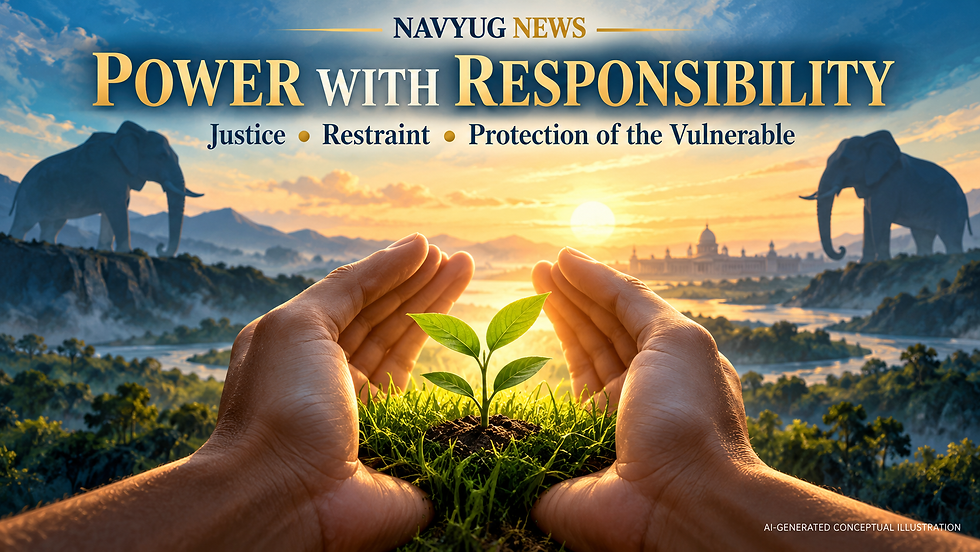
This illustrative scene captures the meaning of the proverb: conflicts between powerful actors often impose disproportionate burdens on people with little influence over the outcome. The elephants symbolize competing centres of power; the grass represents vulnerable individuals, communities and institutions.
The proverb is therefore more than a criticism of conflict. It invites an ethical examination of power: who decides, who benefits and who pays? Its relevance extends from international relations to workplaces, families and the natural environment.
Power and the unequal distribution of consequences
Power allows an actor to pursue objectives, shape choices and resist pressure. Vulnerability limits the ability to influence decisions or recover from their consequences.
This difference explains why the same disruption affects people unequally. A large institution may absorb a temporary loss. A daily-wage worker may lose the income needed for essential purchases. A wealthy household may find alternatives; a poorer household may have none.
The harm is thus not only the immediate event. It also includes the unequal capacity to adapt.
An ethical assessment must look beyond whether an action achieves its stated purpose. It must consider the burdens imposed on those who were not meaningfully involved in choosing it. Otherwise, success for one actor can conceal hardship for many others.
International relations: beyond the contest of states
At the international level, the elephants may be military powers or competing economic blocs. Their disagreements can affect communities outside the direct confrontation through uncertainty over trade, travel and essential supplies.
The precise effects vary, and predictions should not be presented as inevitable. Nevertheless, a strategic discussion is incomplete if it considers territory and influence while overlooking civilian welfare.
Smaller states may also face pressure to align with stronger powers. Their agency can narrow when economic or security relationships leave few alternatives.
For India, the lesson is to assess external choices through national interests and public welfare. Cooperation with different partners should strengthen resilience rather than make citizens dependent on the continuation of someone else’s rivalry.
Responsible diplomacy seeks security while preserving room for dialogue and practical cooperation.
Domestic politics: conflict must serve citizens
Democracy needs disagreement. Public criticism, opposition and peaceful protest can expose failures and enable reform. The proverb should not become an argument for unquestioning obedience.
Its warning concerns political conflict detached from public purpose. If competition becomes solely about discrediting an opponent, the needs of citizens may become instruments rather than objectives.
Consider an illustrative dispute over a public service. Rival groups exchange accusations, but users still need accurate information and functioning facilities. The dispute becomes meaningful when it establishes responsibility and improves the service.
Political legitimacy therefore rests on more than winning an argument. It requires addressing the issue that made the argument necessary.
Institutions can help by providing fair procedures, reliable information and opportunities for participation. They reduce the chance that every disagreement becomes a struggle without clear limits.
Economic conflict and invisible costs
In economic life, disputes between corporations, employers or commercial partners can reach workers, customers and small suppliers.
A business may defend its interests through lawful negotiation. Yet the people depending on it still need clarity about wages, services and obligations. Explaining that another party caused the problem does not complete its responsibility.
The concept of external costs is useful here: a decision can impose burdens outside the actor’s own immediate calculations. If those burdens remain invisible, powerful organizations may underestimate the true consequences of their actions.
Responsible economic conduct requires planning for continuity, communication and fair remedies. It also requires listening to those whose bargaining position is weaker.
Efficiency should not be measured solely by the gains achieved at the top. It should include whether the wider system remains dependable for those supporting it.
Society and family: the metaphor becomes personal
The proverb also applies where authority operates through everyday relationships. A dispute among community leaders can burden residents. A confrontation between adults can affect children who cannot choose their household circumstances.
In a family, the child may become the grass when asked to carry messages, keep secrets or prove loyalty to one adult. The apparent struggle between equals then places pressure on someone with far less control.
The appropriate principle is to keep adult responsibility with adults. Children’s safety and stability should guide decisions concerning them.
This does not mean concealing danger or preserving harmful arrangements. Where abuse exists, protection must take priority.
The broader ethical lesson is that vulnerability creates a responsibility for the powerful. Dependence should invite care, not become an opportunity for control.
The environment: grass in both senses
The metaphor’s environmental dimension is literal as well as symbolic. Competition over resources can damage land, water and ecosystems whose value is not fully represented in a negotiation.
Nature cannot participate at the bargaining table, while future generations cannot vote on present choices. Both can bear consequences without having a voice in the decision.
An intergenerational perspective therefore asks whether immediate gains undermine the conditions needed for future well-being.
Environmental safeguards should be treated as part of responsible decision-making, rather than an afterthought once conflict has produced damage. Assessment, participation and restoration can help bring hidden costs into view.
The same reasoning connects ecology and social justice: those least able to relocate or purchase alternatives may face the greatest difficulty when their surroundings deteriorate.
A necessary counterargument: some conflicts are justified
The proverb can be misused if it suggests that avoiding confrontation is always preferable. Some struggles are necessary to resist aggression, discrimination or exploitation.
A worker challenging unsafe conditions is not responsible for the injustice merely because the challenge creates disagreement. Nor should a person experiencing abuse be asked to remain silent for the sake of harmony.
The ethical distinction lies in the cause, methods and consequences of the struggle. Recognizing civilian harm does not make aggressor and victim equally responsible.
A just objective also does not remove every obligation to exercise restraint. Legitimate resistance should seek to reduce avoidable harm wherever possible.
The task is therefore not the elimination of conflict, but its transformation through accountability, proportionate conduct and effective remedies.
From helpless grass to protected citizens
The grass need not remain powerless. Collective organization, access to information and meaningful participation can help people influence decisions affecting their lives.
Institutional protection matters equally. Fair adjudication, responsive administration and accessible grievance mechanisms can channel disputes away from unchecked confrontation.
A constructive approach has three elements: anticipate harm before acting, protect essential needs during conflict and repair damage afterwards. Responsibility should continue after a public declaration of victory or settlement.
Leadership also requires humility. Decision-makers must be willing to acknowledge consequences they did not foresee and revise their choices in response to evidence.
Ultimately, peace is strongest when it rests on justice, and power is most legitimate when it accepts limits.
The village in the opening scene cannot survive by applauding whichever elephant wins. Its future depends on protecting the land on which life continues. Likewise, societies should assess conflicts through what remains for ordinary people after the powerful leave the arena.
The highest achievement is not merely to defeat another elephant. It is to ensure that the grass can grow again.

Comments