Trump Announces Russia–Ukraine Energy Ceasefire: A Breakthrough Claim Awaiting Confirmation
Navyug News | 12 October 2026
Tagline: A pause in attacks on energy infrastructure could bring relief—but an announcement is only the beginning.

US President Donald Trump has announced an immediate Russia–Ukraine “energy ceasefire”, raising hopes of reduced attacks on infrastructure that supplies fuel and electricity. Yet the announcement has also exposed a crucial gap between a declared diplomatic achievement and an agreement whose terms and implementation are publicly clear.
Reuters reported that Trump made the announcement on 11 October, while Ukrainian President Volodymyr Zelenskyy said he was awaiting details. Moscow did not immediately confirm an agreement. The development should therefore be described as Trump’s announcement, rather than an independently established ceasefire already operating on both sides.
For households, businesses and governments watching the war, the distinction matters. A genuine reduction in energy attacks could provide meaningful relief. It would not, however, automatically end the fighting.
What Trump announced
Trump said Russia and Ukraine had agreed to an energy ceasefire taking immediate effect. His social media announcement did not provide detailed terms, according to Reuters’ initial report.
That leaves important operational questions unanswered. What facilities are covered? When exactly must attacks stop? How long would the arrangement last? Who would establish whether an alleged violation occurred?
These are not technical distractions. They determine whether opposing forces have the same understanding of their obligations. A public statement can indicate diplomatic intent, but a workable arrangement needs enough clarity to guide decisions on the ground.
Navyug News analysis: The announcement’s value will ultimately depend on observable restraint and agreement between the parties, rather than the confidence with which it was presented.
Kyiv’s response and the question of reciprocity
Associated Press reported that Zelenskyy welcomed the possibility of an energy ceasefire but said Russian attacks on Ukrainian energy infrastructure continued. He indicated that Ukraine would halt strikes on Russian energy sites if Russia reciprocated.
This places reciprocity at the centre of the discussion. Each side needs confidence that restraint will not leave its own infrastructure exposed while the other continues attacking.
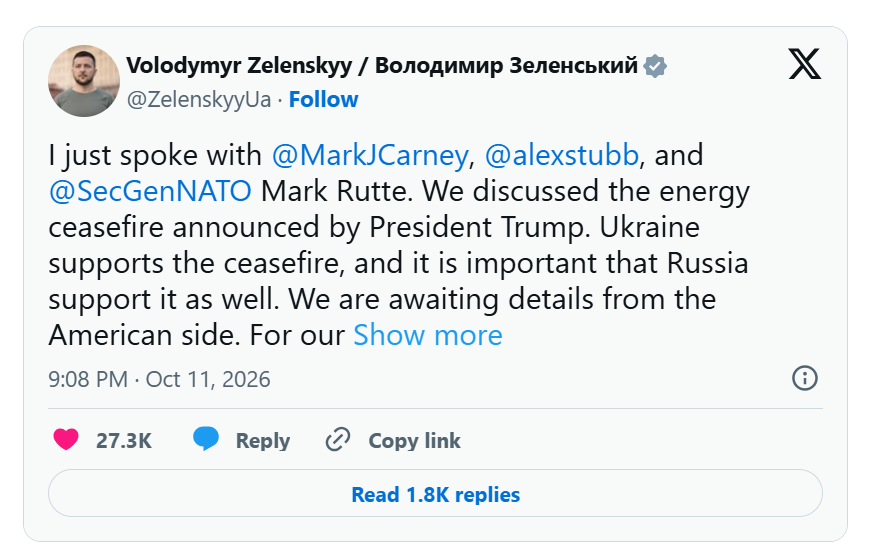
Analysis: Reciprocal arrangements are difficult when trust is low. Even if leaders agree in principle, military instructions, verification and communication must follow. Without those steps, one incident can trigger accusations that the other side never intended to comply.
Readers should distinguish an expressed willingness to accept a ceasefire from confirmation that its full terms have been agreed and put into effect.
An energy ceasefire would have a limited scope
An energy ceasefire generally concerns attacks on specified energy facilities. Its precise meaning here depends on terms that were not publicly detailed in Trump’s announcement.
Possible areas for negotiation could include power generation, electricity transmission, refineries and fuel storage. That list is an explanation of potential scope, not a verified description of this proposed arrangement.
Such a pause would also differ from a comprehensive ceasefire covering the wider war. It would not necessarily settle territorial disputes, stop every category of attack or establish a political peace agreement.
Analysis: A limited arrangement can still be worthwhile. Diplomatic progress need not resolve every issue at once. Protecting essential services may be an achievable first step, provided expectations remain realistic.

Why energy infrastructure matters to civilians
Electricity and fuel support far more than industrial activity. Hospitals need reliable power. Water systems depend on pumping equipment. Homes need heating, and businesses depend on transport and functioning communications.
A reduction in attacks could allow repair crews to work with greater predictability and help households plan around fewer disruptions. Whether those benefits occur would depend on actual security conditions and the infrastructure’s state.
Analysis: This is why the humanitarian importance of an energy pause should be assessed separately from claims of strategic victory. The clearest measure of success would be sustained improvements in access to essential services.
Promises alone cannot provide that relief. Protection must continue long enough for repairs, maintenance and everyday activity to become safer.
Fuel prices add another dimension
The announcement arrived amid concern about global fuel costs. Reuters reported that Trump linked Ukrainian attacks on Russian refineries to rising US diesel prices, with American midterm elections approaching.
That is Trump’s stated argument, not proof that one factor alone explains fuel prices.
Energy markets respond to production, refining capacity, inventories, shipping conditions and expectations about several conflicts simultaneously. A disruption in one location can interact with constraints elsewhere.
Analysis: Political leaders may focus on the cause they believe they can influence. For readers, the more useful question is whether a proposed measure produces additional reliable supply or reduces a demonstrable risk. The answer requires evidence beyond political attribution.
Markets respond before diplomacy is settled
Reuters reported that Brent crude fell to $103.18 a barrel in early Monday trading as expectations of additional Russian supplies combined with Trump’s ceasefire announcement. US West Texas Intermediate also declined.
A market reaction does not establish that an agreement exists or will last. Prices reflect expectations, which can change quickly.
Analysis: Investors may respond to the possibility of fewer disruptions before diplomats resolve the details. If subsequent developments undermine that expectation, some of the initial movement may reverse. Equally, implementation could make the outlook more stable.
A single trading snapshot should therefore be identified by time and treated as context, rather than a forecast of what consumers will pay next month.
Why the diesel deal is a separate question
Trump’s announcement accompanied debate over a proposed Russian diesel supply arrangement. The Washington Post reported criticism from US lawmakers and international partners, including objections relating to sanctions and the implications for Russia’s war financing.
Those objections should be attributed to their speakers. They are not a substitute for a definitive legal assessment.
Analysis: Fuel supply policy and protection of energy infrastructure may influence each other, but they involve different questions. One concerns commercial flows and restrictions; the other concerns wartime conduct. Combining them into a single claim of “peace achieved” would obscure both.
For governments, the challenge is to weigh near-term economic relief against the broader consequences of the terms being offered.
What an enforceable arrangement would need
Several practical elements would help establish credibility: a clearly defined start time, agreed categories of protected facilities, communication channels and a process for examining alleged violations.
Independent observation could also help separate genuine breaches from mistaken attribution or disputed reports. However, no specific monitoring mechanism should be presumed without an announcement confirming it.
Analysis: The strongest arrangement would make restraint verifiable and disputes manageable. Its weakest version would leave every incident subject to incompatible interpretations, allowing the ceasefire to collapse before its benefits reach civilians.
The public should look for published terms and matching commitments, followed by evidence of implementation.
What Indian readers should watch
For India, developments in international energy markets are relevant to transport, business planning and household costs. However, a foreign ceasefire announcement does not automatically translate into an immediate change in domestic retail fuel prices.
Analysis: Any benefit depends on sustained supply conditions and the channels through which global prices affect domestic costs. It is premature to promise cheaper petrol or diesel on the strength of this announcement alone.
More broadly, readers should follow confirmation from both parties, reports about attacks and subsequent diplomatic clarification. Old headlines can remain widely shared even after the situation changes.
Trump’s announcement creates the prospect of a limited reduction in harm. Whether it becomes a credible achievement will depend on what Russia and Ukraine agree to—and what their forces actually do.


Comments